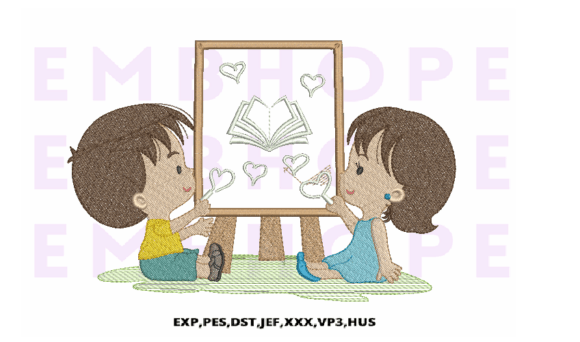
Children Drawing Embroidery Design
A Craft Fair Designer’s Real-World Review
As an embroidery designer who’s prepped over 200 craft fair booths—and shipped thousands of embroidered tote bags, tea towels, and patches—I opened Children Drawing with high hopes. The title alone evokes softness, nostalgia, and approachability—key emotional triggers for handmade shoppers browsing a bustling market aisle. Right away, it reads as cute, modern, and gently playful, not overly themed or seasonal. That’s a huge advantage: while categorized under Back To School, Children Drawing avoids clichés like apples or backpacks. It feels timeless enough for year-round gifting, yet fresh enough to stand out beside more literal school motifs.
First Impression: Sweet, Simple, and Shelf-Ready
The description—“This Cute Drawing will add a lovely accent to any fabric”—tells me this isn’t meant to dominate. It’s an accent design. That’s smart positioning. At a craft fair, customers scan tables in under three seconds. Children Drawing delivers immediate warmth without visual noise: no dense lettering, no intricate shading, no tiny faces or fine linework that blurs on cotton twill. It reads clearly at 3–4 inches wide—ideal for a pocket patch, tea towel corner, or apron bib. That clarity is gold for booth visibility and Etsy thumbnail appeal.
Where It Shines: Product-by-Product Breakdown
- Tote bag design: Perfect centered on the front panel or subtly tucked into a bottom corner. Its light composition won’t overwhelm canvas weight or compete with hand-painted accents.
- Apron embroidery: Ideal for the chest pocket or lower bib. Adds charm without compromising function—no bulky stitch density near seams or ties.
- Tea towel embroidery: Excels here. Works beautifully on linen, cotton, or waffle weave—especially when placed off-center near the hem. The “lovely accent” promise holds true: it enhances, never distracts from utility.
- Embroidered patch: A natural fit. Clean outlines and moderate scale mean crisp edges even after cutting and heat-sealing. Great for swapping onto denim jackets or kids’ backpacks.
- Caps and curved surfaces: Proceed with caution. While the shape is friendly, any tight curves may stretch delicate lines. Best reserved for structured front panels—not flexible side panels or low-profile dad caps.
- Fabric pouches & pillow covers: Strong performers. Scales well between 2.5" and 5", maintains personality at both sizes, and photographs beautifully on neutral backgrounds for printable mockups.
- Market bags & handmade gifts: A standout. Paired with kraft tags and twine, Children Drawing signals thoughtful, small-shop quality—not mass-produced clipart.
What Makes It Sell? Attention, Value, and Consistency
At the booth, Children Drawing draws eyes because it feels human-made: slightly uneven line weight, gentle asymmetry, and implied pencil texture (even if stitched) suggest hand-drawn authenticity. That perception lifts perceived value—shoppers pay more for pieces that feel intentional, not algorithmic. It also reinforces brand consistency across product types: same motif on a tea towel, a pouch, and a patch tells a cohesive story. And crucially, it invites engagement. Parents smile. Teachers pause. Grandparents say, “That reminds me of my granddaughter’s sketchbook.” That micro-moment of connection often closes the sale.
Production Notes Every Embroiderer Should Check
Before stitching your first batch, treat Children Drawing like any commercial embroidery file you’d sell yourself:
- Test on scrap fabric matching your final product—especially textured towels or thick canvas.
- Verify thread contrast: light designs fade on ecru linen; dark threads pop better on oatmeal or charcoal.
- Review spacing and stitch density—avoid unintentional “floaty” gaps or crowded areas that snag during wear.
- Confirm hoop size compatibility. If it’s designed for a 4x4 hoop, don’t force it into a 3x3 without checking registration.
- Use appropriate stabilizer: tear-away for stable cottons, cut-away for knits or stretchy pouch fabrics.
- Create at least one real mockup—not just a digital preview. Lighting, fabric drape, and thread sheen change everything.
- Compare how it looks on multiple fabric colors. What reads sweet on ivory may read washed-out on oat.
- Double-check commercial licensing. Since the description says “Stitch this adorable embroidery on your items,” assume personal use is permitted—but confirm whether finished product resale is covered before listing on Etsy or wholesale platforms.
Careful-Use Considerations
Remember the note: “quality can not be guaranteed when resizing.” That’s not a limitation—it’s a professional heads-up. Avoid shrinking Children Drawing below 2 inches wide; fine details vanish. Don’t enlarge beyond 6 inches unless you’ve re-digitized for fill stability. Steer clear of ultra-dark fabrics unless you’re using bright, high-contrast thread. And skip heavily textured surfaces like bouclé or thick terry—those swallow delicate line work. Also, avoid placing it directly over seams or zippers where distortion risks misalignment.
Final Verdict for Sellers & Makers
Children Drawing is a quietly powerful machine embroidery design for the handmade economy. It’s not flashy—but it’s reliable, emotionally resonant, and commercially versatile. For Etsy sellers, it’s a strong candidate for evergreen listings (not just August back-to-school spikes). For craft fair vendors, it’s a conversation starter that photographs well, stitches consistently, and scales across your best-selling categories—from kitchen textiles to wearable accessories. As a designer, I’d stock it alongside my top five go-to motifs—not because it’s complex, but because it’s kind: kind to fabric, kind to machines, and kind to customers looking for something handmade, heartfelt, and unmistakably human.